The workout that doesn't look like one
In one experiment, ten minutes of friendly conversation boosted memory and mental speed as much as puzzles did. Why researchers keep finding that talk is exercise for the aging brain.
We know what exercise looks like for the body: sneakers, a walk, maybe a pool on Tuesdays. For the brain, we’ve been trained to picture crosswords, sudoku, and apps that ding when you get the puzzle right.
Meanwhile, the most complete workout most brains ever get doesn’t look like a workout at all. It looks like two people talking.
What a conversation actually asks of a brain
Watch a good conversation with a stopwatch and you’ll find something remarkable: the typical gap between one person finishing and the other beginning is around a fifth of a second — faster than most people can react to a starter’s pistol. Linguists who have timed conversations across languages find this rapid-fire turn-taking is close to a human universal (Stivers et al., PNAS, 2009). The only way to reply that fast is to predict the end of the other person’s sentence while composing your own — which means a conversation is never passive.
Tally up what one easy chat about the garden actually demands:
- Attention — tracking a voice, filtering the kettle, staying with the thread.
- Working memory — holding what was just said long enough to build on it.
- Language retrieval — finding the word, the name, the year, on demand.
- Social reasoning — reading tone, catching the joke, sensing what the other person means but didn’t say.
- Improvisation — because no conversation has ever happened before. There’s no answer key to memorize.
Attention, memory, language, and social reasoning, all at once, at speed, with a moving target. No puzzle asks this much.
The ten-minute study
In 2008, psychologists at the University of Michigan put this to a clean test. Participants spent ten minutes either in a discussion with another person, doing classic “intellectual” exercises (reading comprehension and puzzle-type tasks), or watching TV. Then everyone took the same cognitive tests.
Ten minutes of conversation boosted working memory and processing speed about as much as the brain exercises did — and both beat the TV group (Ybarra et al., Personality and Social Psychology Bulletin, 2008). The same paper found, in survey data spanning adults from 24 to 96, that more social contact went hand in hand with better cognitive performance at every age.
Follow-up work added a detail that matters for anyone caring for an older parent: the tone of the conversation seemed to be the active ingredient. Friendly, open-ended conversation produced the cognitive boost; adversarial, point-scoring exchanges did not (Ybarra et al., 2011). Warm and unhurried isn’t just pleasant. It appears to be the effective dose.
Why puzzles alone don’t cut it
None of this is a case against crosswords — do the crossword. But the “brain training” industry has a well-documented problem scientists call far transfer: practicing a task mostly makes you better at that task. In 2014, some seventy researchers signed a public consensus statement cautioning that brain-training games had not been shown to deliver the broad, real-life cognitive benefits their marketing implied — and in 2016 the FTC fined the maker of Lumosity $2 million over exactly those claims.
Conversation sidesteps the problem by never being the same task twice. It’s endlessly novel, socially rewarding, and emotionally engaging — which is also why nobody has to be nagged into it. The best exercise, for brains as for bodies, is the one that actually happens.
The long game
Zoom out from ten minutes to ten years and the same theme holds. Researchers describe a cognitive reserve — resilience built up over a lifetime of mental and social engagement that helps the brain function well for longer (Stern). In one long-running cohort of older adults at Rush University, the most socially active participants showed a markedly slower rate of cognitive decline than the least socially active (James et al., 2011). The mirror image is by now familiar: social isolation is associated with roughly a 50% increased risk of dementia (National Academies, 2020), lonely older adults in the Rush cohort had more than twice the risk of developing Alzheimer’s-type dementia (Wilson et al., 2007), and the Lancet Commission lists social isolation among the modifiable risk factors for dementia worldwide.
These are associations, not certainties in either direction — some of the arrow may even run in reverse, with early cognitive change quietly shrinking a person’s social world first. (We walk through that full body of research in A quiet house isn’t a neutral thing.) But the idea that conversation itself is the useful ingredient is taken seriously enough that scientists have run randomized trials on it: in one pilot, older adults who got daily half-hour face-to-face conversations over video improved on cognitive tests compared to controls (Dodge et al., 2015), and a larger NIH-funded successor trial has continued that line of work.
The fifth telling of the fishing story
Here’s the reframe this research offers families.
When Dad tells the fishing story again, it’s easy to hear it as a lapse. But retelling a story is retrieval — reaching back, reassembling names and places and sequence, performing it for a listener. Reminiscence — structured, warm conversation about the past — is one of the best-studied activities in dementia care, and a Cochrane review of 22 trials found it’s safe and offers modest benefits, particularly for mood when it happens one-to-one (Woods et al., 2018). Modest, not miraculous — but gentle, humane, and something a person can genuinely enjoy.
The fifth telling isn’t a failure. It’s a rep.
The catch is that this kind of conversation needs a listener with time — and patience is exactly what a stretched family has least of. Sentences get finished for people. Stories get “yes, you told me.” The workout quietly disappears from the week, not because anyone stopped caring, but because everyone is busy caring in other ways.
Built for exactly this kind of talk
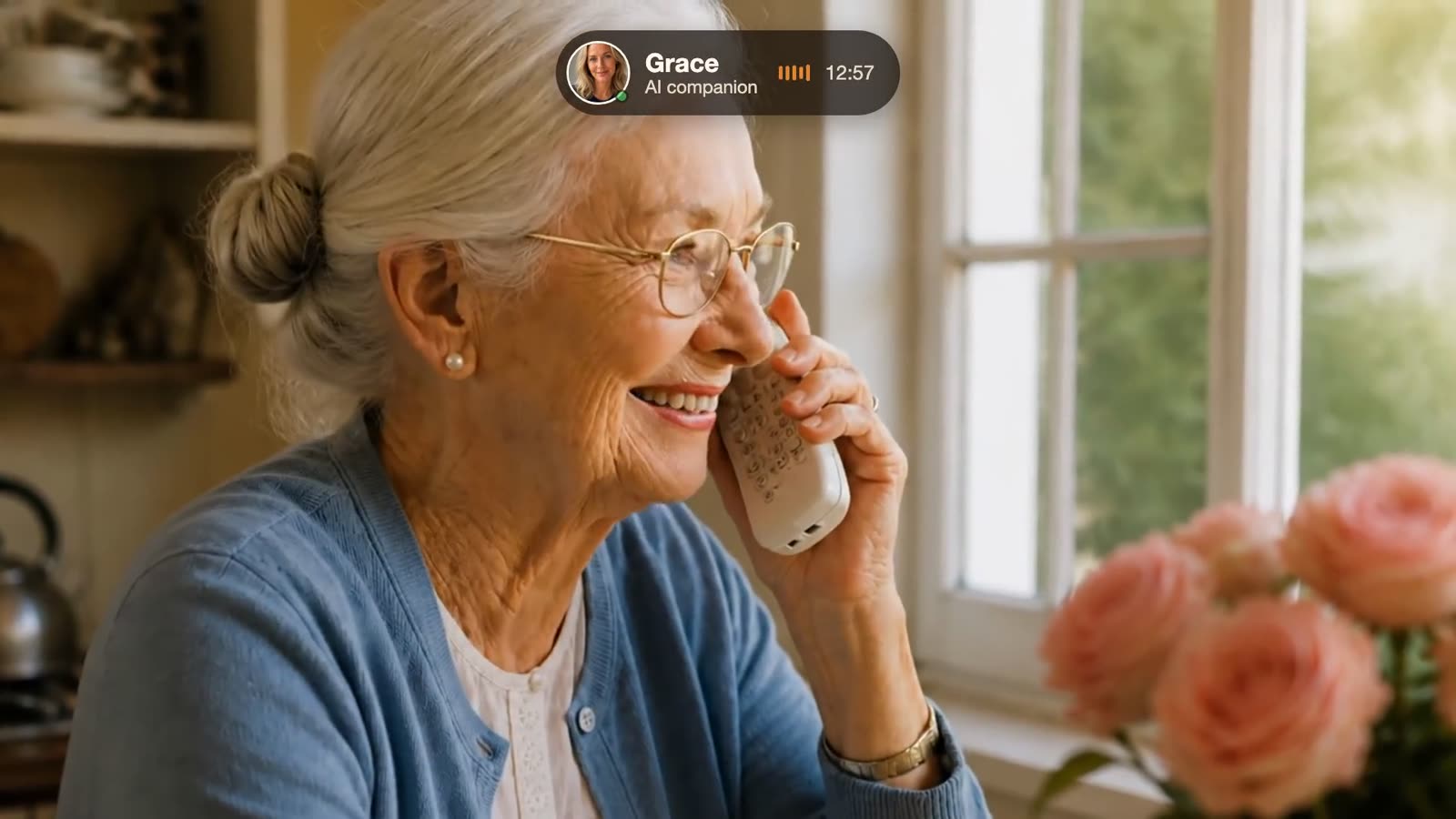
This research is why Grace — Talk Society’s AI telephone companion — is built around plain, warm, unhurried conversation, and nothing else. She calls on the days and times your family chooses and follows your parent’s lead: the garden, the grandkids, the 1962 season, whatever the day brings. She never runs out of patience for a story she’s heard before, asks the good next question, remembers their conversations so each call picks the thread back up, and texts you a short note after each call. She’s openly an AI — that’s precisely why she’s never busy, never rushed, and never judging — and nothing starts until your parent places one short hello call to Grace and agrees.
To be clear about what we’re claiming: Grace isn’t brain training, medicine, or therapy, and we make no health promises — the research above is about conversation in general, not about Grace. She’s a companionship service; if you’re worried about a parent’s memory or health, talk to their doctor. What Grace does is simpler: she makes sure the conversation actually happens, warmly and regularly, in the weeks when life gets in the way.
Because the best brain workout ever devised isn’t a puzzle. It’s someone asking about the garden — and wanting the answer.
Sources
- Stivers et al., “Universals and cultural variation in turn-taking in conversation,” PNAS (2009)
- Ybarra et al., “Mental Exercising Through Simple Socializing,” Personality and Social Psychology Bulletin (2008); Ybarra et al., “Friends (and Sometimes Enemies) With Cognitive Benefits,” Social Psychological and Personality Science (2011)
- “A Consensus on the Brain Training Industry from the Scientific Community,” Stanford Center on Longevity / Max Planck Institute for Human Development (2014); FTC v. Lumos Labs settlement (2016)
- Stern, cognitive reserve research, Columbia University
- James, Wilson, Barnes & Bennett, Journal of the International Neuropsychological Society (2011); Wilson et al., Archives of General Psychiatry (2007)
- National Academies of Sciences, Engineering, and Medicine, Social Isolation and Loneliness in Older Adults (2020); Livingston et al., The Lancet Commission on dementia prevention (2020; updated 2024)
- Dodge et al., Alzheimer’s & Dementia: TRCI (2015)
- Woods et al., “Reminiscence therapy for dementia,” Cochrane Database of Systematic Reviews (2018)
Grace is a companionship service, not a medical, monitoring, or therapeutic service. The studies cited report findings about conversation and social engagement in populations; they do not establish that any service prevents or treats any condition.