A quiet house isn't a neutral thing
What fifteen years of research says about loneliness, conversation, and an aging parent's wellbeing — and why a regular, warm phone call is a bigger deal than it looks.
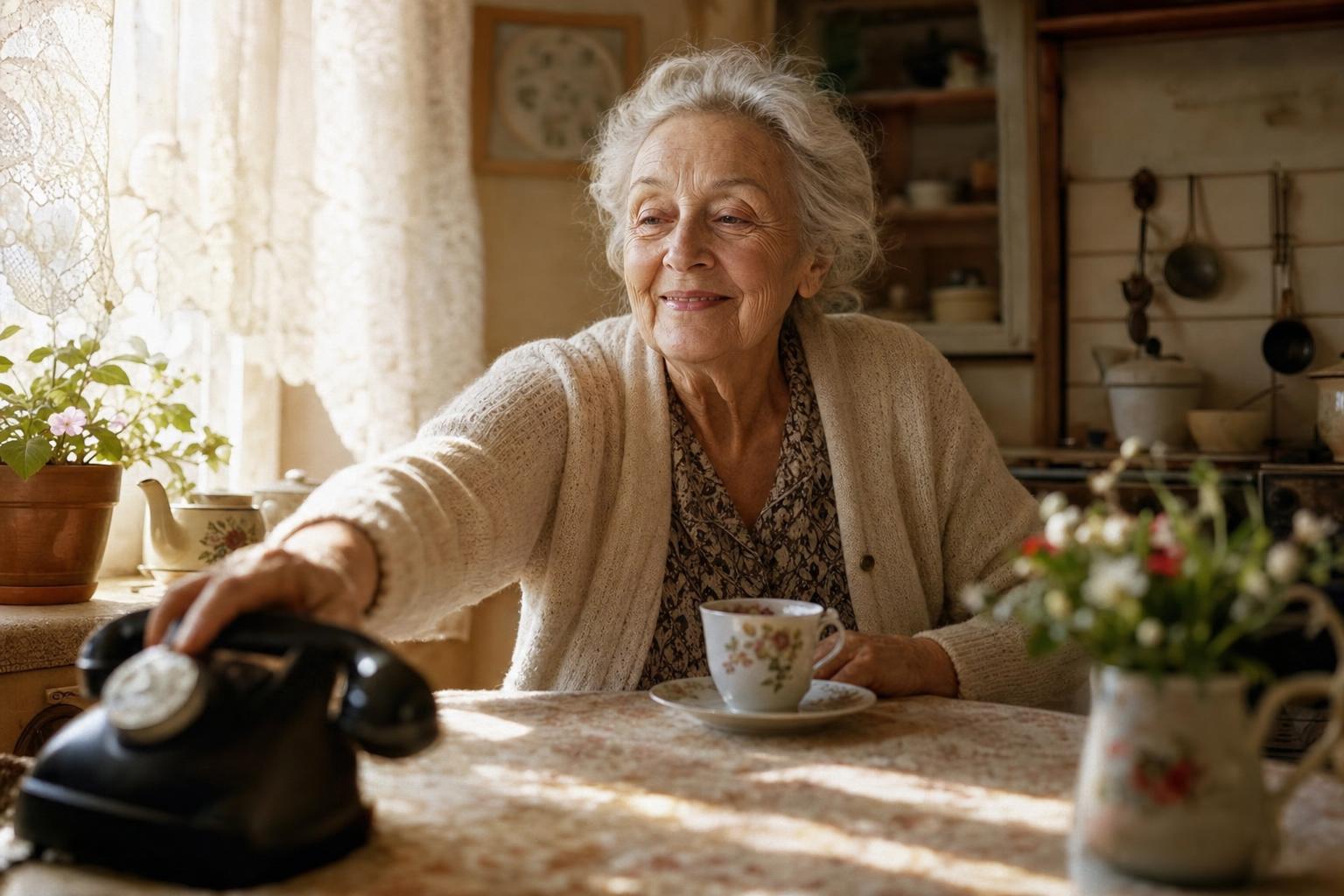
You call when you can. Between work, kids, and the four hundred small logistics of your own life, you call on the drive home, on Sunday afternoons, in the gap between one thing and the next. And still, most of your mother’s days have long stretches where the phone doesn’t ring and the house is quiet.
It’s tempting to file that quiet under “peaceful.” The research says otherwise. Over the last fifteen years, loneliness and social isolation in older adults have gone from a soft, sentimental concern to one of the most heavily studied risk factors in public health — serious enough that in 2023 the U.S. Surgeon General issued a formal advisory calling loneliness and isolation an epidemic, noting that lacking social connection can increase the risk of premature death as much as smoking up to 15 cigarettes a day.
That’s a striking sentence to attach to something as ordinary as nobody calling. Here’s what sits underneath it.
Loneliness is common, and it isn’t cosmetic
Roughly a quarter of Americans aged 65 and older are considered socially isolated — objectively low on contact, not just feeling blue — and around 43% of adults over 60 report feeling lonely, according to the National Academies of Sciences’ 2020 consensus report on the subject. One detail from that research is worth pausing on: most older adults who report loneliness are not living alone. Loneliness isn’t about headcount. It’s about whether anyone is genuinely talking with you — and listening.
The health associations are not subtle:
- In a landmark meta-analysis of 148 studies covering more than 300,000 people, those with stronger social relationships had a 50% higher likelihood of survival over the study periods than those with weaker ones — an effect comparable to well-established risk factors like smoking, and larger than obesity or inactivity (Holt-Lunstad et al., PLoS Medicine, 2010).
- A follow-up meta-analysis across 3.4 million people found social isolation, loneliness, and living alone were each associated with a 26–32% increase in early mortality (Holt-Lunstad et al., Perspectives on Psychological Science, 2015).
- Poor social connection is associated with a 29% higher risk of heart disease and a 32% higher risk of stroke (Valtorta et al., Heart, 2016).
- Adults who often feel lonely have more than double the odds of developing depression (Mann et al., 2022). And the arrow appears to point the way you’d fear: in a five-year study of older adults, loneliness predicted later depressive symptoms — not the other way around (Cacioppo et al., Psychology and Aging, 2010).
- Among community-dwelling adults over 60, those who reported feeling lonely had a 45% higher risk of death and a 59% higher risk of losing day-to-day functional independence over six years (Perissinotto et al., Archives of Internal Medicine, 2012).
These are associations from observational research — science can’t randomly assign people to a decade of loneliness, so no one can claim conversation causes longer life. But the pattern is large, consistent, and repeated across millions of people. Public-health bodies now treat social connection the way they treat sleep, diet, and exercise: a pillar, not a garnish.
The mind, specifically
For families, the sharpest worry is usually cognitive. Here the research is just as pointed.
The National Academies report — and the CDC, citing it — found that social isolation is associated with about a 50% increased risk of dementia. In a well-known study from Rush University’s Memory and Aging Project, older adults who scored high on loneliness had more than twice the risk of developing Alzheimer’s-type dementia over four years compared to those who scored low (Wilson et al., Archives of General Psychiatry, 2007). The Lancet Commission on dementia prevention now lists social isolation among the modifiable risk factors that, together, account for a large share of dementia cases worldwide.
Researchers are honest about the limits: some of this may run in reverse, with early cognitive change quietly shrinking a person’s social world before anyone notices. Nobody can promise that conversation prevents dementia, and you should be suspicious of anyone who does. But there’s a good reason scientists keep circling back to conversation in particular.
Conversation is one of the most complete workouts a brain gets. A real back-and-forth requires holding the thread of what was just said, retrieving words and names on demand, following a story across interruptions, reading tone, taking another person’s perspective, and composing a reply in real time — attention, working memory, language, and social reasoning, all at once, at speed. In one set of experiments, just ten minutes of conversation measurably boosted working memory and processing speed, performing on par with classic “brain exercise” activities (Ybarra et al., Personality and Social Psychology Bulletin, 2008); a follow-up found the friendly, open-ended kind was the version that helped (Ybarra et al., 2011). In one long-running cohort of older adults, the most socially active participants showed a markedly slower rate of cognitive decline than the least socially active (James et al., 2011). Small randomized pilots have even tested conversation directly as an intervention — daily half-hour face-to-face chats over video — and found improvements on cognitive tests in older adults (Dodge et al., 2015).
None of this requires puzzles, apps, or drills. The stimulation researchers keep measuring is the ordinary magic of someone asking about the garden and actually wanting the answer.
(We go deeper on this research — the ten-minute study, why puzzles alone don’t cut it, and the case for the fifth telling of the fishing story — in its own post: The workout that doesn’t look like one.)
The other half: something to look forward to
There’s a second, quieter mechanism, and anyone who has watched a parent perk up in the days before a visit already knows it.
Psychologists have found that anticipation is itself a source of happiness — in one Dutch study of 1,530 adults, people were measurably happier in the weeks before a planned trip than people with nothing on the calendar (Nawijn et al., 2010), and lab research finds looking forward to an event stirs stronger feeling than looking back on the same event (Van Boven & Ashworth, 2007). Rhythm matters too: in a study of adults aged 65–84, social contact that came at consistent, predictable times was associated with better day-to-day mood (Luo et al., Journals of Gerontology, 2024). And in Rush’s cohort, older adults with a stronger sense of purpose — of having a role, of being expected somewhere — were substantially less likely to develop Alzheimer’s disease over the following years (Boyle et al., 2010).
A call on the calendar is a small thing. But “Tuesday at ten, the phone will ring for me” is structure, anticipation, and a role, all in one — a warm moment they can count on, in a week that may not have many fixtures left in it.

Where Grace comes in
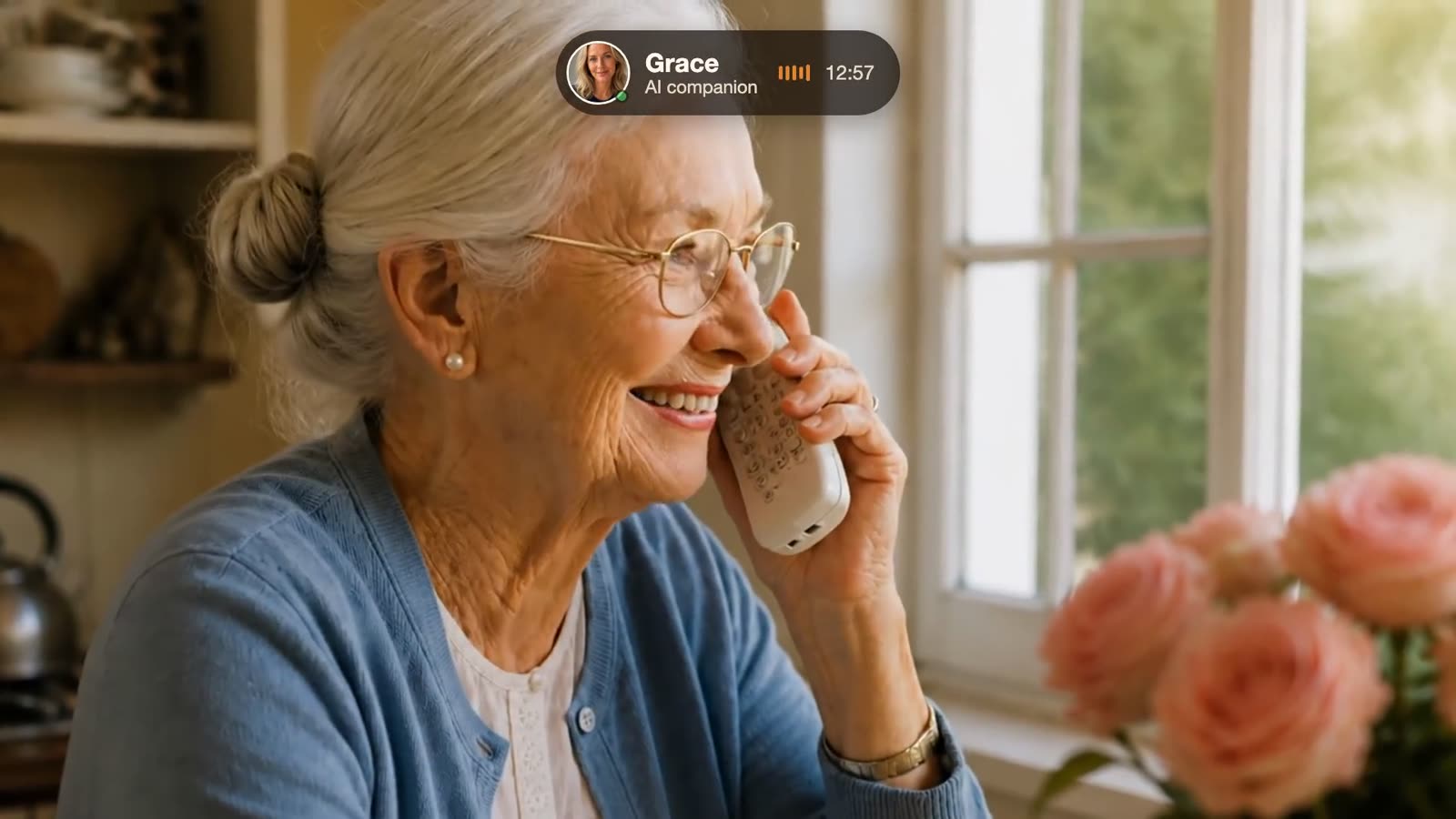
This is the research Talk Society built Grace around. Grace is an AI telephone companion — we say that plainly, because it’s the honest description and, for this job, the advantage. She calls your parent on the schedule your family chooses and simply talks with them: how the day is going, the grandkids, a favorite show, the old days. She follows their lead — no pressure, no checklist — remembers their conversations so it feels like catching up rather than starting over, and texts you a short note after each call so you stay close to the thread of their days.
Being an AI is precisely what lets her do the one thing the science keeps pointing at — regularity:
- She always calls when she’s supposed to. Never busy, never double-booked, never runs out of patience on a story she’s heard before.
- She never judges. Your dad can tell the same joke, take his time finding a word, or say the thing he wouldn’t say to worry the family. With Grace, saying anything is safe.
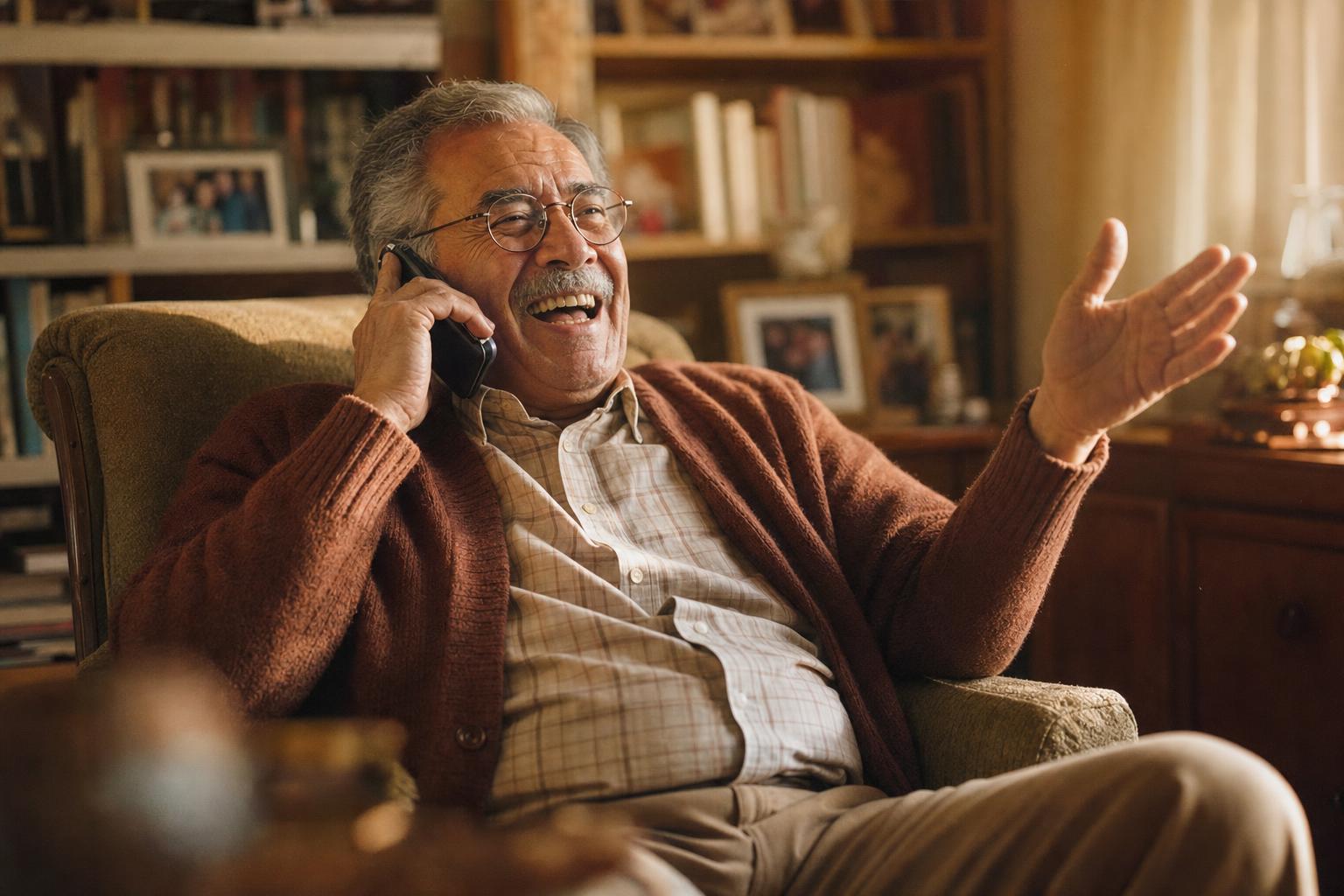
- She’s endlessly interested. Big-band records, the 1962 season, roses, bridge — she can meet nearly any interest and ask the good next question.
And she’s honest company: Grace is openly an AI, introduces herself as one, and never pretends to be human. Nothing starts unless your parent is comfortable — they place one short hello call to Grace themselves and agree before any of her calls or billing begin.
One more thing the research argues for, indirectly: you. If you’re the one who’s always there, you’re carrying something heavy — a majority of dementia caregivers report high emotional stress, and the classic finding on caregiver health is that it’s unrelieved strain, not caregiving itself, that corrodes (Schulz & Beach, JAMA, 1999). Day-level studies show that on days caregivers get a genuine break, their stress exposure and mood measurably improve (Zarit et al., 2014). While Grace keeps your mother happily chatting, you get a real window to catch your breath — and a note when the call’s done.
What this is, and what it isn’t
We won’t dress this up as medicine, because it isn’t. Grace is companionship — real conversation, on a rhythm your family chooses. She is not a clinician, a therapist, a monitoring service, or a substitute for your visits and calls; she offers company and a note after her calls, never a promise that someone is safe or a reason to skip checking in yourself. The research above is about social connection in general, not about Grace, and no companionship service — human or AI — should promise health outcomes. If you’re worried about a parent’s memory, mood, or health, talk to their doctor.
What we will say is this: the scientific case that regular, warm conversation belongs in an older person’s week — alongside sleep, movement, and a decent lunch — is about as strong as observational science gets. And it’s the rare risk factor you can do something about this week, gently, without asking your parent to change a single thing about who they are.
They just have to pick up the phone. Someone lovely is calling.
Grace’s plans start at $97/month, and your first 14 days are free — the calls begin as soon as your parent agrees, and your card isn’t charged until 14 days later. Cancel before then and you’re never charged at all. Details on the pricing page.
Sources
- Office of the U.S. Surgeon General, Our Epidemic of Loneliness and Isolation (2023)
- National Academies of Sciences, Engineering, and Medicine, Social Isolation and Loneliness in Older Adults (2020)
- Holt-Lunstad, Smith & Layton, PLoS Medicine (2010); Holt-Lunstad et al., Perspectives on Psychological Science (2015)
- Valtorta et al., Heart (2016)
- Mann et al., Social Psychiatry and Psychiatric Epidemiology (2022); Cacioppo, Hawkley & Thisted, Psychology and Aging (2010)
- Perissinotto, Stijacic Cenzer & Covinsky, Archives of Internal Medicine (2012)
- Wilson et al., Archives of General Psychiatry (2007); James et al., Journal of the International Neuropsychological Society (2011); Boyle et al., Archives of General Psychiatry (2010)
- Livingston et al., The Lancet Commission on dementia prevention, intervention, and care (2020; updated 2024)
- Ybarra et al., Personality and Social Psychology Bulletin (2008); Dodge et al., Alzheimer’s & Dementia: TRCI (2015)
- Nawijn et al., Applied Research in Quality of Life (2010); Van Boven & Ashworth, Journal of Experimental Psychology: General (2007); Luo et al., Journals of Gerontology, Series B (2024)
- Schulz & Beach, JAMA (1999); Zarit et al., The Gerontologist (2014); Alzheimer’s Association, Alzheimer’s Disease Facts and Figures (caregiving chapter)
Grace is a companionship service, not a medical, monitoring, or therapeutic service. The studies cited report statistical associations in populations; they do not establish that any service prevents or treats any condition.